
Each person has a unique relationship with food, from the first introduction where there’s little choice as to the menu, to a lifelong evolving palate carved from new flavors, textures, and aromas. Then there are the lucky ones who get to add direct farm-to-fork and stem-to-mouth experiences. This was my early childhood in St. Elizabeth, Jamaica, living among an abundance of rotating fruiting trees and seasonal edibles on vines, stalks, shrubs and in the ground. While this expanded my palate, I’ve often wondered how I survived my early childhood wanderings and food curiosity.
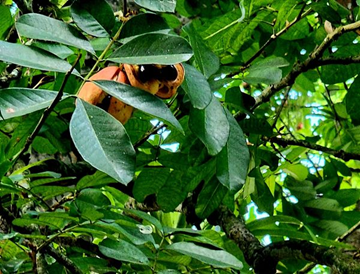
Picture of Ackee Fruit posted by K. Valerie in Jamaican Foods.
My ackee memories exist in stages. The strongest memory, however, is not a taste memory. It was the experience as a young child looking up at what appeared to be “eyes” in the form of the bulging shiny black seeds in an opened ripe ackee on a tree in my Mooma’s (Grandmother) yard. Adding to this startling encounter was the hushed sound of the rustling wings of a large bird feeding in the high canopy of the majestic nearby bread fruit tree. This was further memorialized when I stepped distractedly onto a ripened fruit smashed against the rocky path introducing me to the “frequently to-be-encountered” decaying tropical fruit mush, complete with feeding insects and crawlies. Growing up in this tropical Garden of Eden required me to get comfortable with the cycle of growing and dying things. This ackee memory was just a part of my young self, processing my environment.

Cleaning Ackee is done by hand, a labor intensive effort. Photo: Jamaican Gleaner
In another childhood ackee memory, I served as a link in the farm-to-table chain, tasked with cleaning ripe ackees for cooking. Easy to do but can only be done by hand as captured in the picture of a commercial ackee operation above. Cleaning involves removing the edible yellow flesh from the red pod, pulling out the large black seeds from the flesh and removing a tendril that runs along the folds of the flesh. I saw myself as “old enough” because I shadowed my Mooma and had a close-up as to how it should be done. I recall tasting a piece of the uncooked flesh and experiencing just how bland it was in contrast to how tasty it would become when cooked and paired with the right partner.
Ackee like tomatoes, another fruit eaten as a vegetable, falls into a class of transforming foods—mild enough to marry flavors without overpowering its partners and in the process creating new flavors. At that stage of my childhood, I certainly loved its pairing with salted cod or salt fish as it is called in the Caribbean—a combination that has rightfully elevated Saltfish & Ackee to become Jamaica’s National Dish.
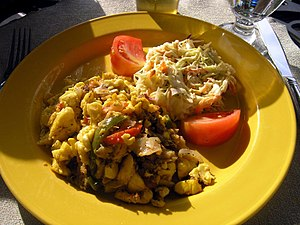
Picture from Wikipedia
While I was too young to cook Ackee & Saltfish in Jamaica, I knew how it should taste from excellent home cooks who cooked with ingredients intensely flavored from Jamaica’s “terroir”— its unique soil, climate, sunlight and micro-climates . The challenge was how to duplicate this in a foreign land. Like Rice and Peas, Escovitch Fish, and other outstanding Jamaican dishes, Ackee & Saltfish became a challenge to master in America.
Flavoring freshly picked ackees is not often a step in preparing Ackee & Salt Fish in the United States, unless someone has brought some from Jamaica, or you’re in parts of Florida with homegrown ackees. So, when preparing Ackee & Saltfish in the US you are likely using cooked ackees canned in a brine. Like most canned vegetables, they lose some flavor, can become too soft and can easily fall apart. So, the approach to an excellent Ackee & Salt Fish dish is to treat the canned ackee with respect and gingerly fold it into the seasoned Salt fish at the last stage of the preparation.
As to the selection of canned Ackees, there are many good options as there are 12 brands which export ackees to the US., some too broken up for my liking. Choosing is pretty much determined by your personal preference and how much you’re willing to pay. Some may remember when selling canned ackees was prohibited in the US , or so they say, because of the concern that un-ripened ackees contain a poison .
Yet, during that period, while prohibited in the US, it was sold in Canada and UK and became the popular “ask” to those traveling to those countries—“bring me some ackee” which was dutifully hidden from the custom inspector. Some US Caribbean grocers, however, sold it on the black market, took advantage of the prohibition, charged what the market would bear for this precious food, selling it at premium prices to Jamaican Americans longing for home and willing to pay this illegal tariff. This contraband was hidden under the counters. You had to know to ask for it.
My approach then has been to master the saltfish partner in the Ackee & Saltfish marriage by delving into its components. and finding substitutes or added ingredients or techniques to approximate the flavors from the redolent herbs and spices grown in Jamaica.
Chasing this flavor has become a lifetime challenge, which has included exploring how others have approached it, asking questions of excellent cooks, and sometimes asking questions of no one in particular. Cooks in Jamaica may puzzle at the effort to attain the flavor so easily available in Jamaica.
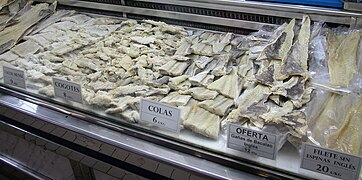
Picture of salted cod from Wikipedia
As to the Salt Fish, over the years, I have experimented with or asked –what is the best saltfish to select, should it be the packages with thicker fleshy fish avoiding the thin stringy parts , is it best to use cod or can another salted fish work, what is the best way to remove the salt—is it by boiling, or by repeated changes in room temperature water, just how much of the salt should be removed to not affect the consistency or flavor, should it be hand shredded or cut up or both to achieve greater penetration of the spices and herbs , what is the best ratio of fish to ackee, what about using fresh cod for those concerned with salt, and isn’t this just another variation on the dish?
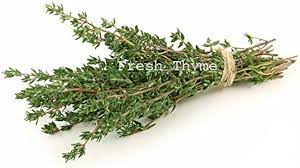
Amazon picture
As to the seasonings, can any dried thyme work or should there be a combination of fresh and dried, should you only use fresh and how do you select from the great variety of thymes offered in grocery stores, can you find Jamaican thyme locally and does it compare with your memory?
How do you replace the intense escallions in Jamaica given that available scallions, or green onions are pretty flavorless, should you supplement it with other onions, if so, what type and what about supplementing with a dash of onion powder, should you add bacon or other substitutes in search of the missing underlying umami, should you add scotch bonnet pepper (or a small dab of good jerk seasoning)?
What is the role of black pepper in this dish, should it be freshly ground? If you add tomatoes, which are the best type to add, should they be deseeded, should they be fleshy, should you roast them such as roasted Romas or cherry or grape tomatoes combined with sun-dried tomatoes?
Can the allspice be enhanced if toasted then ground up, or is it best to just include the whole allspice berry (and remove later), does the age of the allspice matter, should you start the sauté with olive oil or a nonflavored oil with a little coconut oil, should you add sweet peppers and minced garlic?
Whether you are able to duplicate this Jamaican flavor is very subjective.
After all of this effort, don’t be upset, however, if when you share your masterpiece with your American friends, someone either thinks it is an egg dish or as I vividly remember my ex-husband, Henry, saying I love the eggs but I’m not so sure about the fish.

 NCAFFA Caribbean Food Alliance